Adding Sales Channels Without Real-Time Inventory Sync? That Growth Can Wreck Your Margin

Nathan Dahl
Co-Founder @ Fore Show Golf & Tracka
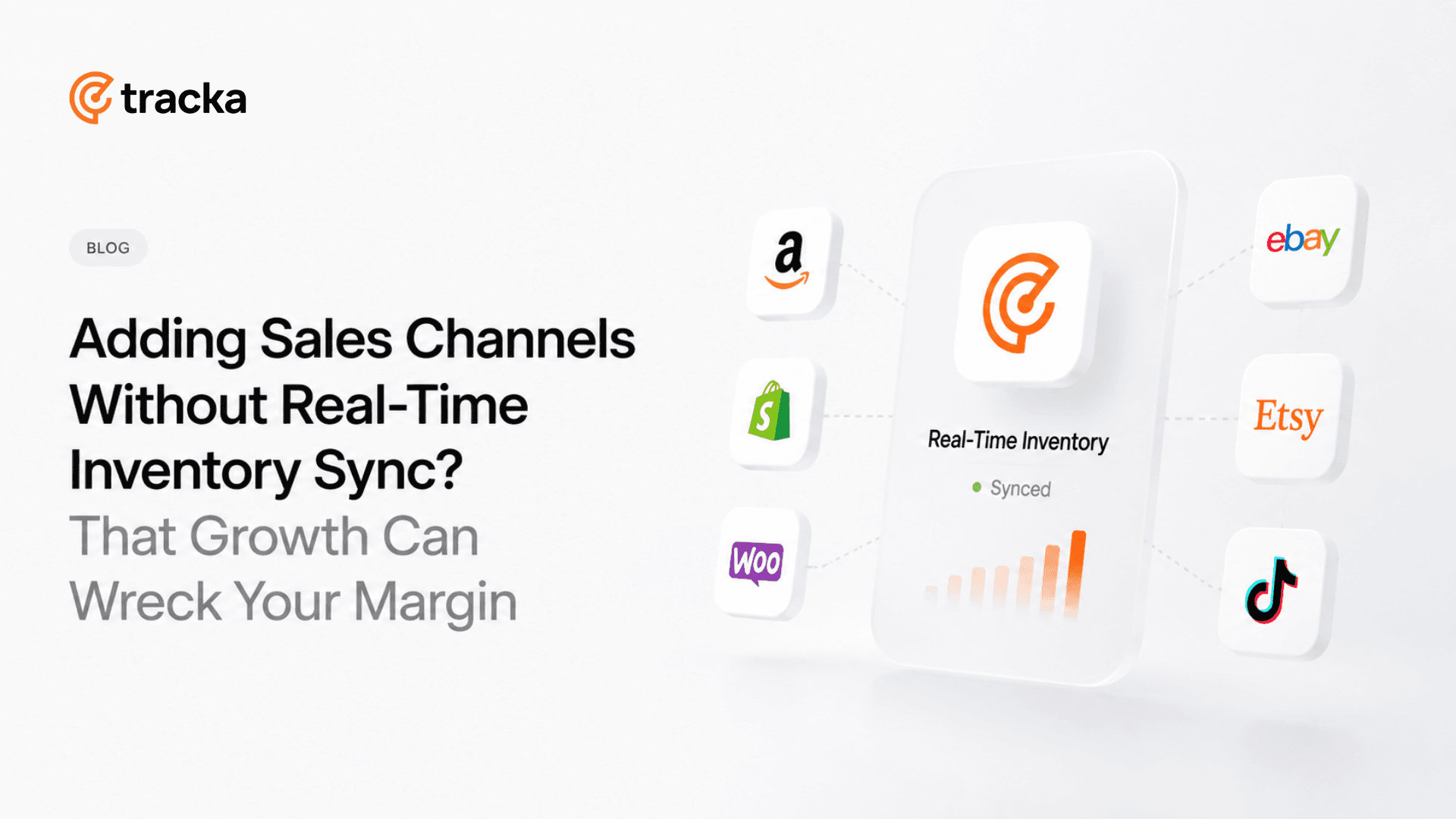
Adding Amazon, TikTok Shop, or Etsy to your Shopify store feels like a growth move. More channels, more customers, more revenue. And it can be, but only if your inventory infrastructure can actually keep up.
Here's the problem most founders don't see until it's too late: every new channel you add is making the same promise to customers. "Yes, we have that in stock." If your inventory isn't updating across all those channels in real time, you're making promises you can't keep, and paying for it in cancellations, refunds, support tickets, and lost customer trust.
The real issue isn't demand generation. It's promising the same stock to multiple channels at once, without a system that can referee in real time.
The pressure to expand is real. TikTok Shop US sales hit $15.82 billion in 2025 and are projected to reach $23.41 billion in 2026. Every founder sees those numbers and wants in. But the brands quietly bleeding margin aren't the ones who skipped TikTok Shop. They're the ones who added it before fixing their inventory plumbing.
What Actually Breaks When You Add Channels Without Real-Time Sync
Here's the mechanics of how it fails.
Each platform, Shopify, Amazon, TikTok Shop, Etsy, keeps its own inventory count. Unless a central system pushes an update to every channel the moment an order comes in, each platform is working from a stale number. That gap between "what the platform thinks you have" and "what you actually have" is where oversells happen.
It plays out like this:
Order comes in on Shopify. Your count drops from 10 to 9.
Amazon and TikTok Shop still show 10. Their sync hasn't run yet.
Two more orders come in on Amazon and TikTok Shop simultaneously. Both go through.
You now have 3 orders for 2 units. Someone is getting a cancellation email.
That sequence is manageable when you're running one channel. It becomes a daily operational fire when you're running three or four.
The problem compounds fast during high-volume moments. A creator posts about your product on TikTok. Orders spike in 20 minutes. If your sync runs every 15-30 minutes (which is common, even with "automated" tools), you're overselling into that spike with no way to stop it in real time.
Shopify's own enterprise guide on multichannel inventory puts it plainly: manual synchronization across platforms is nearly impossible at scale and directly increases out-of-stocks, deadstock, and preventable returns. That's not a warning about bad software. That's a warning about the structural problem of managing one inventory pool across multiple demand sources without a real-time layer connecting them.
The Hidden Margin Leak Founders Miss
Most founders think about overselling as a customer service problem. Fix the order, send an apology, move on. But the financial damage runs much deeper than the refund.
Here's what a single oversell or stockout actually costs:
Wasted ad spend. You paid to drive traffic to a product page. The customer couldn't buy, or worse, bought and got canceled. That CAC is gone.
Refund processing costs. Payment processors don't refund their fees. Every canceled order costs you money even after the refund clears.
Support ticket load. "Where's my order?" and "Why was my order canceled?" tickets eat your team's time. At scale, that's a real labor cost.
Repeat purchase damage. A customer who gets a cancellation email is unlikely to come back. You paid to acquire them once. You won't get a second chance.
Marketplace account health. Amazon's Order Defect Rate metric tracks cancellations. Enough of them and your account gets flagged, suppressed, or suspended.
The numbers behind this aren't small. According to compiled industry research from Opensend, 69% of shoppers will buy from a competitor when an item is unavailable, and 55% may not return after repeated stockout experiences. Roughly 20% of cart abandonment is tied to stockouts discovered late in the buying journey, meaning customers who were ready to buy left because you couldn't fulfill.
This is a finance problem wearing an ops costume. Every stockout and oversell is an invisible line item that doesn't show up cleanly on your P&L, but it's draining margin on every channel you're running.
The brands that scale multichannel profitably aren't the ones with the most channels. They're the ones who treated inventory control as a revenue protection system before they added demand sources.
Quick gut check: If you're already seeing any of the above symptoms, your current setup may not be ready for another channel. See if Tracka can help you get real-time visibility before you expand.
How to Know If Your Current Setup Can Handle Another Channel
Before you flip the switch on a new marketplace, run through this honestly.
Signs your setup is already at its limit
Your inventory syncs on a schedule, not on order events. If updates push every 10, 15, or 30 minutes, you have a lag window. That window is where oversells live.
You rely on spreadsheets or manual reconciliation. This works for one store. It breaks the moment the same SKU is live in three places.
You keep conservative buffer stock as a workaround. Holding extra units to protect against sync lag is a real cost. You're tying up cash to compensate for a system gap.
Your team avoids running promotions on certain SKUs. If you're afraid to promote a product because you might oversell it, that's your infrastructure telling you something.
Support tickets spike around stock-related confusion. "I ordered this but it was out of stock" or "my order was canceled" tickets are a signal, not just a nuisance.
You've had marketplace listings paused or flagged. Amazon and TikTok Shop both penalize sellers for fulfillment failures. If it's happened once, the risk of it happening again goes up with every channel you add.
What this actually means
If two or more of those apply to your current setup, adding another channel won't fix the problem. It will multiply it. Every new demand source you add increases the surface area for the same failure mode.
The good news: you don't need enterprise infrastructure to fix this. You need a single source of truth for inventory that updates across channels in real time, not on a schedule.
What a Channel-Ready Inventory Setup Actually Looks Like
The gap between a fragile setup and a channel-ready one isn't about complexity. It's about where inventory truth lives and how fast it travels.
Fragile Setup | Channel-Ready Setup | |
|---|---|---|
Inventory source of truth | Each platform holds its own count | One central system owns the count |
Update trigger | Scheduled sync (every 10-30 min) | Order-event driven (updates on every transaction) |
Oversell protection | Buffer stock held manually | Automated channel buffers + low-stock alerts |
Visibility | Check each platform separately | Single dashboard across all channels |
Promotion confidence | Avoid promoting risky SKUs | Run promotions knowing counts are accurate |
Audit process | Manual reconciliation, often reactive | Automated discrepancy detection |
The table above isn't about features. It's about outcomes. A channel-ready setup means you can add Amazon, TikTok Shop, or Etsy without creating a new category of operational risk.
Shopify's multichannel inventory guidance identifies lack of centralized visibility and poor software integrations as the core blockers to scaling across channels. The solution isn't more manual process. It's removing the human reconciliation step entirely by letting a central system handle it automatically.
That's what Tracka is built to do: keep inventory counts accurate and synchronized across every channel you're selling on, so you can focus on growth instead of firefighting.
Expand Channels After You Fix the Plumbing
The right sequence for multichannel growth isn't "add channels, then deal with inventory." It's the opposite.
With TikTok Shop projected to hit $23.41 billion in US sales in 2026, the pressure to expand is only going to increase. That's real opportunity. But it's only opportunity if you can actually fulfill the demand you generate.
Here's the honest three-step sequence that works:
Audit your current setup. Use the checklist above. If two or more warning signs apply, you have a system problem, not a channel problem.
Get real-time inventory visibility in place. One source of truth, updating on order events, with automated alerts and channel buffers.
Then add the channel. Now expansion is a growth move, not a gamble.
You don't need to build a warehouse operation to do this right. You just need inventory infrastructure that moves as fast as your sales do.
Is your current setup ready for another channel? See how Tracka handles real-time multichannel inventory sync and find out before you expand.