Inventory Management for Ecommerce: The Hidden Operational Costs Most Sellers Miss

Nathan Dahl
Co-Founder @ Fore Show Golf & Tracka
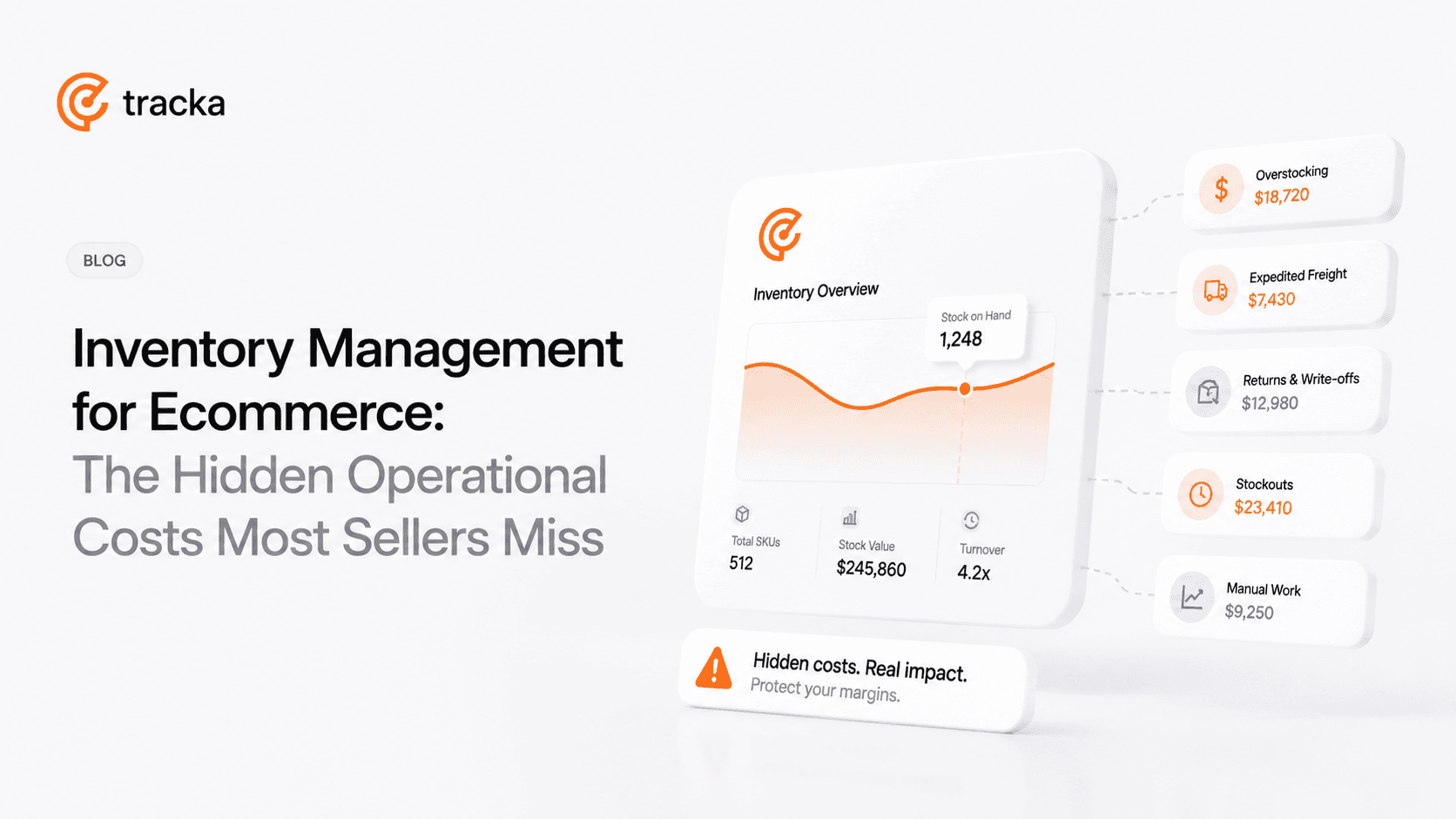
You sell out on Amazon. Great. Except your Shopify store kept taking orders for another four hours because the stock count hadn't updated yet. Now you've got 23 oversells, a wave of cancellation emails to send, and a customer service queue that's going to ruin your afternoon.
Sound familiar? Most operators I talk to describe this as a "multichannel problem." Too many channels, too much complexity. But that framing doesn't actually fix anything, because the root cause isn't the number of channels you're on. It's two much more specific failures: delayed inventory updates and weak reorder logic.
According to Shopify's product availability research, inventory distortion costs retailers more than $1.7 trillion globally. And Baymard Institute's long-running cart abandonment data puts average abandonment rates near 70%, a number that climbs fast when buyers hit out-of-stock walls or get cancellation notices after purchase.
The hidden costs stack up quickly:
Oversells that require manual cancellations and refunds
Emergency purchase orders placed at premium prices
Marketplace penalties for order cancellation rates
Support tickets and negative reviews from unfulfilled orders
Hours of manual stock reconciliation across channels every week
This post breaks down why these problems keep happening even when you already have inventory software, and what to do about it.
What Good Inventory Management for Ecommerce Actually Means
Inventory management for ecommerce is not just counting units. It is the process of keeping stock accuracy, availability, purchasing, and fulfillment aligned across every channel you sell on, in near real time.
That distinction matters. A lot of operators have inventory visibility, meaning they can see their stock counts. What they're missing is inventory alignment, meaning those counts are accurate, current, and consistent everywhere a customer can buy from them.
A well-run inventory system should be able to answer three questions at any moment:
What is available to sell right now, across every channel?
What is already committed to open orders and not actually available?
What needs to be reordered, and when does it need to ship to avoid a gap?
If your current setup can't answer all three without manual checking, you have a process problem, not just a software problem.
For multichannel sellers on Shopify, Amazon, TikTok Shop, or Etsy, the standard isn't perfection. It's fast enough synchronization and clear enough replenishment rules that costly mistakes become rare instead of routine.
The Two Failure Points Behind Most Oversells and Stockouts
Strip away the surface-level chaos and most inventory problems trace back to the same two operational failures.
Failure Point 1: Delayed Inventory Updates
When a sale happens on one channel, your available quantity needs to change everywhere else immediately. Not in 15 minutes. Not on the next scheduled sync. Immediately.
Most sellers running Shopify and Amazon together discover this the hard way. Amazon fulfills an order, but the Shopify listing doesn't reflect the deduction until the next polling cycle. In the gap, another buyer purchases the same unit. Now you have an oversell, a cancellation, and a potential account health flag on Amazon.
Failure Point 2: Weak Reorder Logic
Static reorder points, "reorder when stock hits 50 units," were designed for businesses with predictable demand and consistent supplier lead times. Most ecommerce brands have neither.
Demand spikes around promotions, seasons, and marketplace algorithms. Supplier lead times shift. Yet most operators set a reorder threshold once and leave it untouched for months, which means they're either sitting on overstock or running out before the next shipment lands.
Failure Point | What It Looks Like | What It Actually Costs |
|---|---|---|
Delayed inventory updates | Oversells after a channel sells out | Cancellations, refunds, marketplace penalties |
Weak reorder logic | Stockouts between purchase orders | Lost sales, emergency shipping, missed demand |
These two problems compound each other. Stale stock signals create bad purchasing decisions, and bad purchasing decisions create more stock instability. Fix one without the other and you're still firefighting.
How to Diagnose Whether Your Process Is the Problem
Before you change any tools, run this self-audit. It takes less than an hour and will tell you exactly where your process is breaking down.
1. Measure your sync delay. Pick any sale from last week. How long did it take for that sale to reduce available quantity on every other channel you sell on? If you can't answer this, that's your first problem. If the answer is "more than a few minutes," that's your second.
2. Count your manual stock corrections. Pull your inventory adjustment log for the last 30 days. How many corrections were made by hand? If that number is more than a handful, you're compensating for a broken sync process with human labor.
3. Check for quantity mismatches across channels. Right now, go look at the same SKU on Shopify and Amazon. Do the quantities match? If they don't, you're already mid-oversell risk.
4. Review your last three emergency purchase orders. Were they genuinely unpredictable, or did demand signals exist that your reorder rules ignored? Most operators find the signals were there; the thresholds just weren't set to catch them.
5. Audit your reorder points against actual lead times. When did you last update your reorder thresholds? If it was more than a quarter ago, your rules are probably out of sync with current supplier performance and demand patterns.
Key takeaway: If more than two of these checks surface a problem, your inventory chaos is process-driven, not channel-driven. That's actually good news, because process problems are fixable.
A More Reliable Operating Model for Multichannel Sellers
Here's what better actually looks like in practice. Not a technology stack, an operating model.
One Source of Truth for Available Inventory
Every channel reads from the same centralized stock count. When a unit sells anywhere, every other channel updates immediately, not on a schedule. This eliminates the sync gap that creates oversells.
The practical requirement: your inventory system needs to push updates via webhooks or near real-time API calls, not batch polling every 15 or 30 minutes. Polling-based sync is the single most common architectural reason oversells keep happening.
Reorder Logic Tied to Real Data
Reorder points should be calculated from three inputs: current sales velocity by channel, supplier lead time, and a safety stock buffer for demand variability. A static threshold ignores all three.
When you tie reorder triggers to actual velocity data, you stop placing emergency orders and start placing planned ones. That shift alone reduces premium freight costs and stock anxiety significantly.
Low-Stock Alerts Before the Problem, Not After
Alerts that fire when you're already out of stock are too late. A well-configured system alerts you when you're approaching a reorder point, giving you enough lead time to act before the stockout happens.
The full operating model looks like this:
Centralized inventory with real-time sync across all channels
Dynamic reorder points updated by sales velocity and lead time
Low-stock alerts with enough runway to reorder without rushing
Purchase order management tied directly to inventory triggers
Regular exception reviews instead of constant reactive firefighting
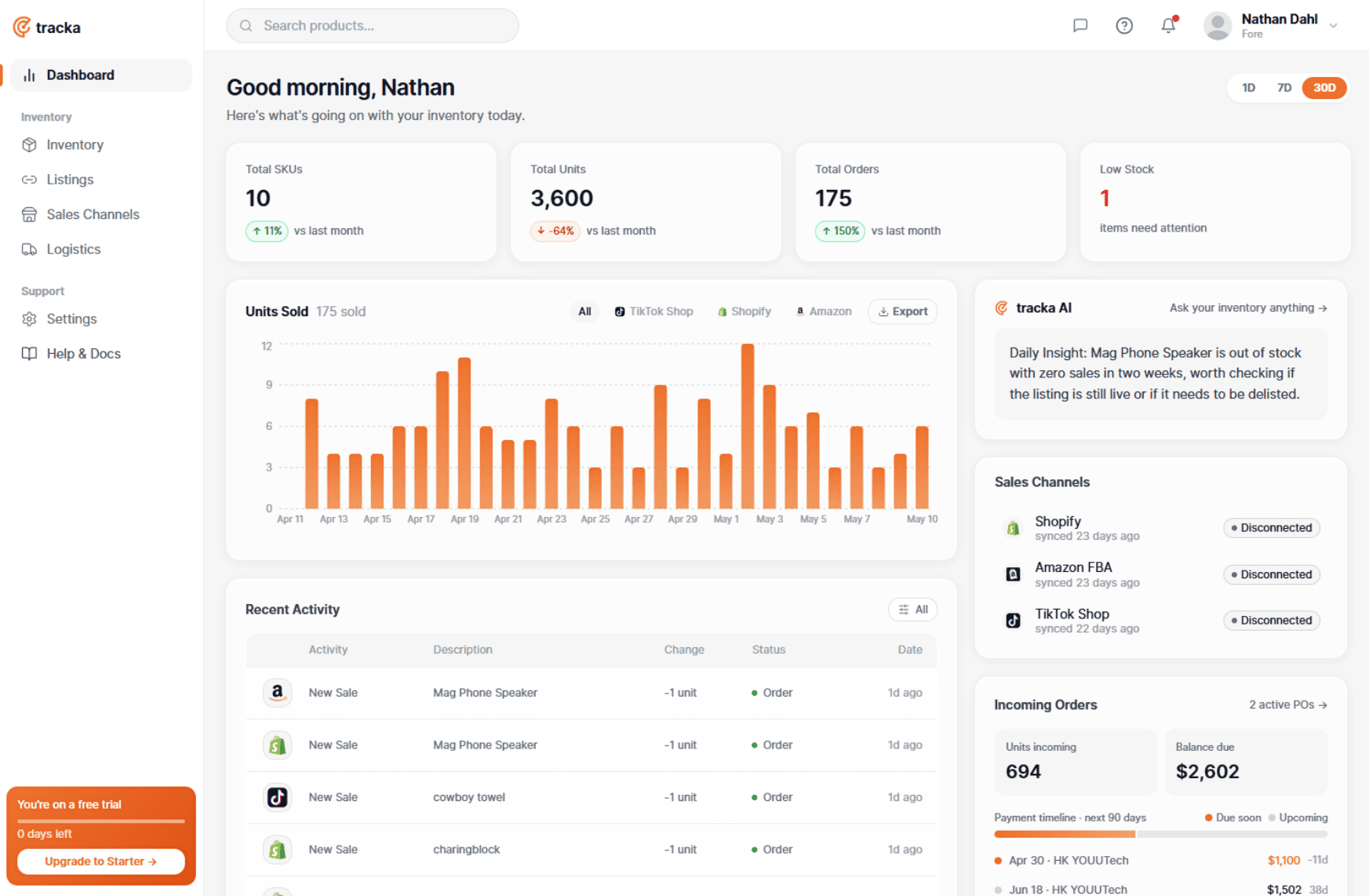
Tracka is built around exactly this model: real-time inventory updates, purchase order management, low-stock alerts, and AI-powered sales analytics that surface demand signals before they become stockout surprises.
What to Fix First This Week
You don't need to overhaul everything at once. Start here:
Day 1: Measure your sync delay. Time how long it takes a sale on one channel to update inventory everywhere else. Write it down. That number is your baseline.
Day 2: Pull your manual correction log. Count the adjustments made in the last 30 days. If it's more than five, you're running a manual patch on a broken process.
Day 3: Audit one reorder rule. Pick your highest-velocity SKU. Does its reorder point reflect your current supplier lead time and recent sales velocity? Update it if it doesn't.
By end of week: Compare your tool stack against the gaps. Check your current setup against the four pillars: real-time sync, dynamic reorder logic, pre-stockout alerting, and centralized PO management. Where are the gaps? That's your roadmap.
The inventory chaos most sellers live with isn't inevitable. It's the predictable result of stale signals and outdated rules. Fix those two things and the firefighting stops.