How to Prevent Stockouts Across Shopify, Amazon, TikTok Shop, and Etsy - Without Living in Spreadsheets

Nathan Dahl
Co- Founder @ Fore Show Golf & Tracka
You ran out of stock again. Not because demand was unpredictable. Not because your supplier let you down. Because by the time your Shopify store noticed the sale on Amazon, three more orders had already landed.
That's the multichannel stockout story most founders don't tell: it's not a forecasting problem, it's a systems problem. Your inventory is fine. Your visibility into it isn't.
The real cost isn't the missed sale. It's everything that comes after it.
When you go out of stock across Shopify, Amazon, TikTok Shop, or Etsy, here's what actually happens:
Customers cancel orders and don't come back
Support tickets pile up for items that show as "in stock" but can't ship
Amazon suppresses your listing or docks your seller metrics
You rush a reorder at a higher unit cost to fill the gap
You oversell on one channel because another channel's sale didn't sync in time
You compensate by holding more safety stock, which ties up cash and creates deadstock risk
According to Shopify's guide to multichannel inventory management, poor inventory visibility is one of the top operational challenges for growing ecommerce brands, and it directly fuels both stockouts and negative customer experiences.
This post walks through the root causes, the real cost math, and a practical system for preventing stockouts across all four channels.
Why Multichannel Sellers Keep Running Out of Stock
Most brands that hit recurring stockout problems aren't doing anything obviously wrong. They're just running a system that was never designed for four channels at once.
There are three root causes that show up again and again.
1. Each channel has its own inventory count
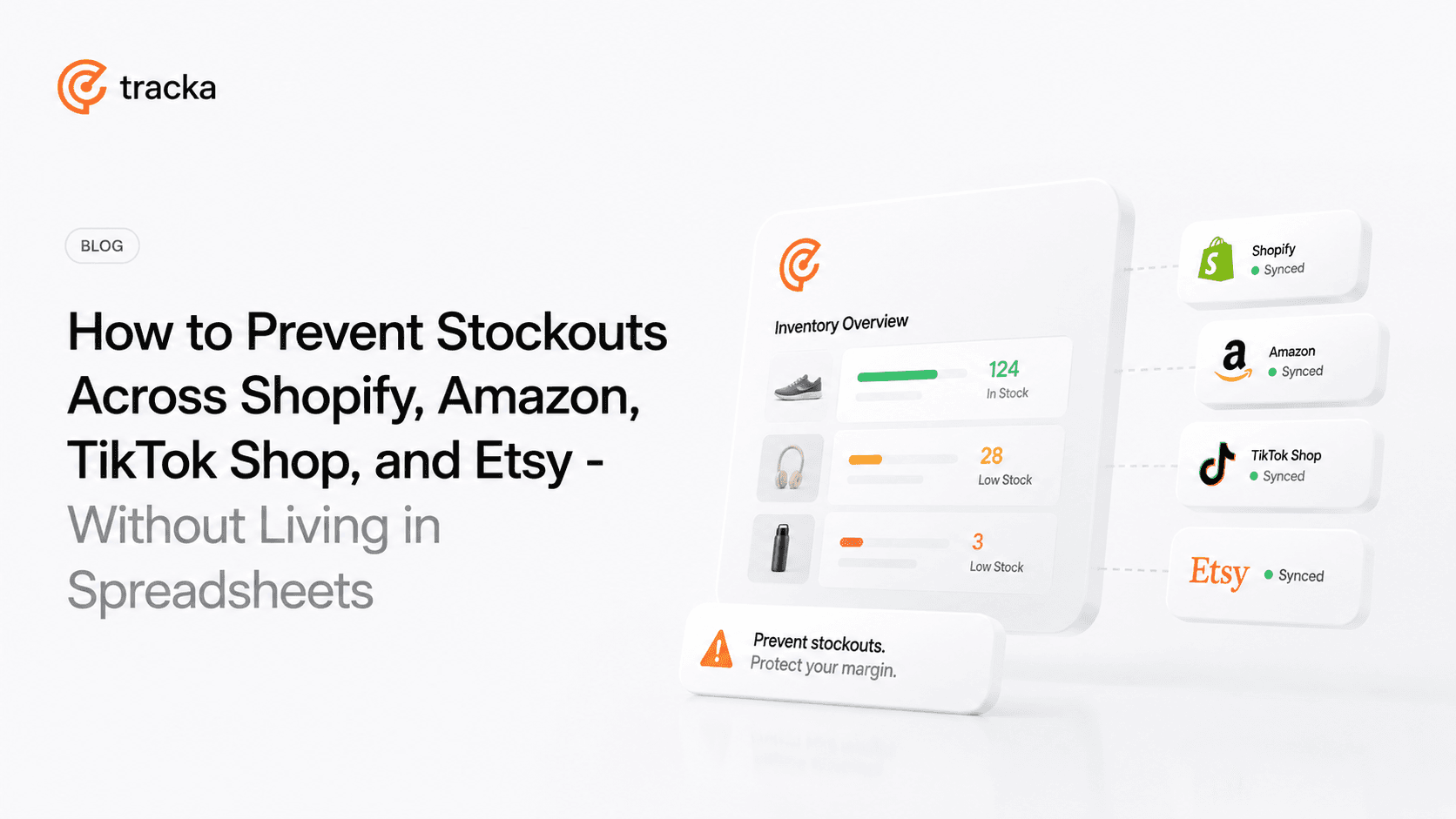
Shopify shows 47 units. Amazon shows 52. Etsy shows 44. TikTok Shop shows 49. None of them are wrong, exactly, but none of them are synced in real time either. The moment a sale hits one channel, every other count is stale.
That lag, even if it's just a few minutes, is where oversells live.
2. Manual updates break at the worst possible moments
CSV uploads, manual quantity edits, and connector chains work fine at low volume. They fall apart when:
A creator posts about your product and TikTok Shop spikes overnight
A return hits Amazon while you're mid-reorder
You run a flash sale on Shopify while your Amazon inventory is already low
There's no such thing as a manual process that can keep up with demand volatility across four channels simultaneously.
3. Purchase orders and sell-through aren't connected
Most brands track POs in a spreadsheet and live inventory in their platforms. Those two systems never talk to each other. So when you're 10 days out from a reorder arriving and you're selling fast, there's no automated signal telling you to slow down or pause listings.
McKinsey's research on omnichannel operations is clear on this: leading operators don't dedicate inventory to individual channels. They run a shared pool with shared planning. Brands still siloing by channel are fighting the system instead of using it.
The Cost-of-Chaos Math Founders Usually Miss
Here's the part that stings. The missed sale is the smallest part of the damage.
Most founders look at a stockout and think: "We lost X units at $Y margin." That's the visible cost. The hidden costs are what actually kill the business case for staying manual.
Visible Costs | Hidden Costs |
|---|---|
Lost sale revenue | Customer reacquisition cost (paid ads to win them back) |
Refund processing | Support team time on "where's my order" tickets |
Cancelled order fees | Amazon listing suppression and ranking drop |
Expedited reorder freight | Seller rating damage and review hits |
Deadstock from over-buying to compensate | |
Team hours reconciling inventory across platforms |
The deadstock problem is worth calling out specifically. When you don't trust your inventory data, the instinct is to hold more safety stock. That feels safe, but it quietly ties up working capital and creates a second margin leak when that stock doesn't move.
Shopify notes that poor inventory management creates carrying-cost pressure, deadstock buildup, and negative customer experiences simultaneously. It's not one problem, it's three compounding problems with the same root cause.
The real ROI of fixing your inventory system isn't just fewer stockouts. It's recovering the margin that's quietly leaking out of every channel right now.
A Practical System to Prevent Stockouts Across 4 Channels
The good news: this is a solvable problem. You don't need perfect demand forecasting. You need a system with four working parts.
Step 1: Build one source of truth for available inventory
Every channel should read from the same stock pool. Not four separate counts that sync occasionally. One number, reflected everywhere.
This is the foundation. Without it, every other fix is temporary.
What this looks like in practice:
A central inventory layer that all channels pull from
Returns, adjustments, and manual corrections all hitting one place
No channel "owning" inventory that another channel can't see
Step 2: Sync every sale in near real time
A sale on Amazon should update your Shopify, TikTok Shop, and Etsy counts within seconds, not minutes. The longer the sync delay, the bigger your oversell window.
This matters most during demand spikes: a creator post, a Prime Day-adjacent sale, a viral moment on TikTok. Those are exactly the moments manual sync falls apart.
Step 3: Set reorder points based on lead time and velocity, not gut feel
Your reorder point should be calculated, not estimated. The formula is simple:
Reorder point = (average daily sales x supplier lead time in days) + safety stock buffer
If your supplier takes 14 days and you sell 20 units per day, you need to reorder before you hit 280 units. Add a buffer for variability. Build that number into your system as an alert threshold, not a mental note.
Adjust your reorder points before:
Seasonal peaks (Q4, back to school, summer)
Planned promotions or creator campaigns
Marketplace events like Prime Day or Etsy sales
Step 4: Run a weekly exceptions review
Even a well-synced system needs a human check. Once a week, review:
SKUs approaching reorder thresholds
POs that are delayed or unconfirmed
Channels where sell-through is outpacing forecast
Any listings that went out of stock and need to be relaunched
What This Looks Like in the Real World
Frameworks are useful. Workflows are what you actually run on a Tuesday morning.
Here's how this system translates into a weekly operating rhythm:
Monday: Stock review
Pull up your low-stock alerts across all channels
Check incoming POs and confirm ETAs with suppliers
Flag any SKUs where sell-through is ahead of forecast
Midweek: Demand adjustment
Review any upcoming promotions, creator posts, or marketplace events
Adjust reorder points or pause listings on lower-priority channels if stock is tight
Confirm that any recent returns have been processed and inventory updated
Daily: Trust the sync, act on exceptions
Stop manually checking four dashboards every morning
Let your inventory system surface anomalies instead of hunting for them
Respond to alerts, not to routine checks
The goal here isn't perfect forecasting. Demand will always surprise you. The goal is fewer surprises and faster correction when they happen.
A brand running this system doesn't eliminate stockouts entirely. But they catch a low-stock situation 10 days out instead of the morning after it happens. That's the difference between a managed reorder and an emergency freight bill.
The shift isn't from reactive to perfect. It's from reactive to early.
When Spreadsheets Stop Being Enough
Spreadsheets aren't the enemy. For a single-channel brand with 20 SKUs, they work fine.
The problem is that most founders keep using them long past the point where they make sense. Here's an honest look at where they hold up and where they don't:
Where spreadsheets work:
One or two channels with predictable, low-volume demand
Small SKU catalogs where manual updates are manageable
Early-stage brands still figuring out which channels to invest in
Where spreadsheets break down:
Four channels with different sync speeds and demand patterns
SKU counts above 50, especially with variants
Any time you run promotions, creator campaigns, or seasonal pushes simultaneously
When a team member is sick and no one else knows which tab to update
The tipping point is when your team spends more time reconciling inventory than making decisions about it. That's the signal.
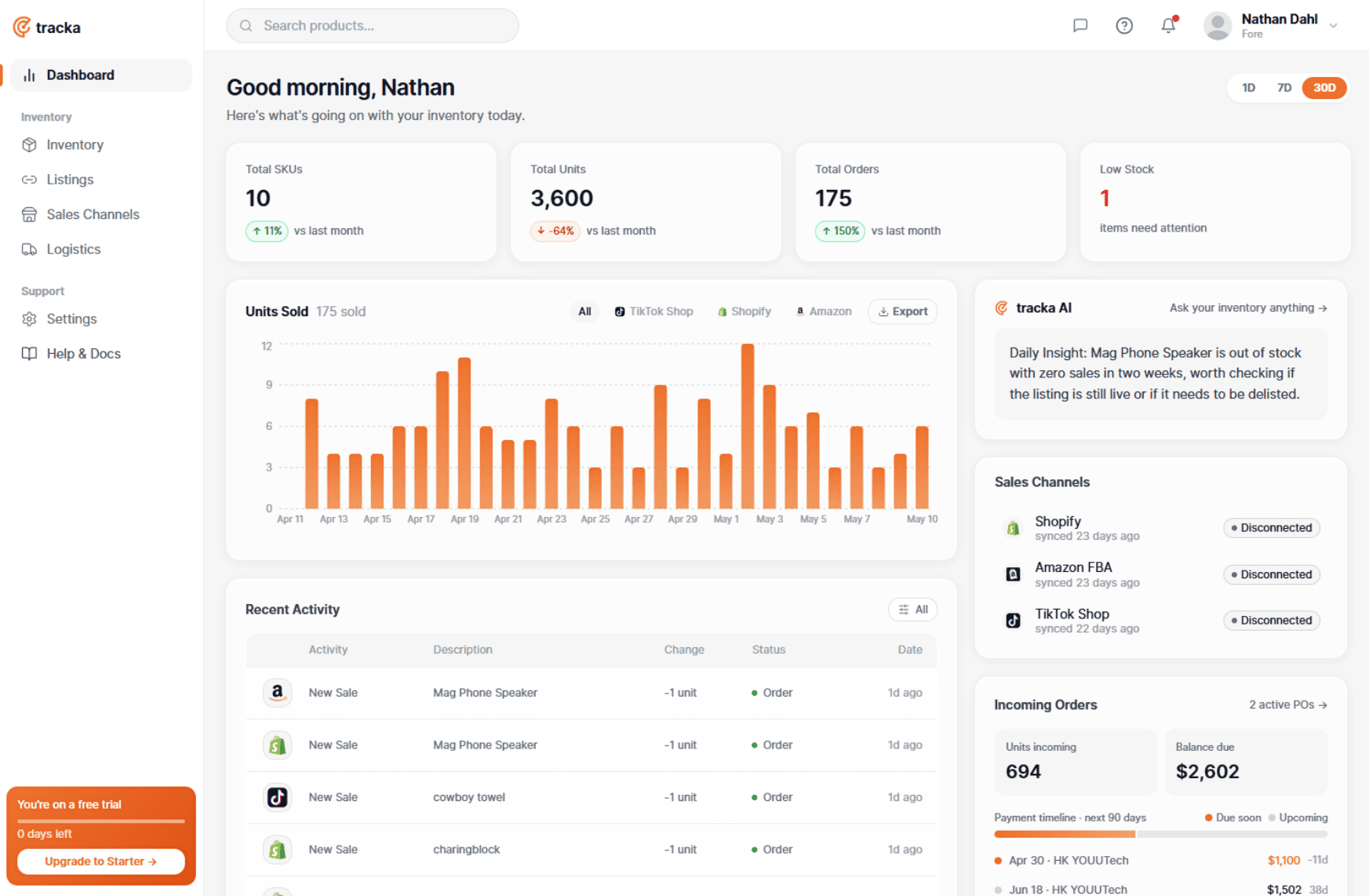
Tracka is built for exactly this point in a brand's growth: one stock pool across Shopify, Amazon, TikTok Shop, and Etsy, real-time two-way sync, purchase order tracking, low-stock alerts, and AI-powered inventory insights that surface reorder risk before it becomes a stockout.
It's the system described in this post, built and maintained for you.
Prevent Stockouts by Fixing the System, Not Just the Symptom
Stockouts across Shopify, Amazon, TikTok Shop, and Etsy are almost always preventable. Not by predicting demand perfectly, but by running inventory as one connected system instead of four separate ones.
The three things that make the biggest difference:
One source of truth: every channel reads from the same stock pool
Near real-time sync: a sale anywhere updates everywhere, fast enough to matter
Reorder rules tied to lead time: not gut feel, not a spreadsheet reminder, a calculated threshold with an alert
If you're still reconciling inventory manually across channels, the chaos isn't going to fix itself as you scale. It compounds.
Try Tracka if you want multichannel inventory sync, real-time stock visibility, and reorder intelligence built for brands selling across Shopify, Amazon, TikTok Shop, and Etsy.