Why Manual Inventory Management Breaks When You Sell on Amazon, Shopify, and TikTok Shop
Lessons from scaling Fore Show Golf to nearly $1M in multi-channel ecommerce sales

Nathan Dahl
Co-Founder @ Fore Show Golf & Tracka Inventory
Quick answer
If you sell on Amazon, Shopify, TikTok Shop, and other channels at the same time, manual inventory management eventually stops working.
At first, spreadsheets and manual updates feel manageable. Then one product takes off, orders start hitting from multiple places at once, and your stock count turns into guesswork. That is when oversells, canceled orders, stockouts, and account health problems start stacking up.
The real problem usually is not demand.
It is visibility.
Once you go multi-channel, inventory is no longer just a stock problem. It becomes a sync-speed problem.
After scaling Fore Show Golf to $1 million in multi-channel ecommerce sales, my co-founder and I learned that the hard way. We built Tracka because nothing we tried handled inventory the way real operators actually need it to.
The day we went viral and almost lost our Amazon account
Two of our TikTok videos hit multi-million views overnight. By 9 a.m., our traffic was up nearly 100x. Orders were coming in across Amazon, Shopify, TikTok Shop, and Etsy at the same time.
At first, it felt unreal. This was our first real breakout moment, and my co-founder and I were packing orders as fast as we physically could.
Then inventory started getting low.
For the next two hours, we had browser tabs open everywhere trying to manually figure out how many units were left on each platform while packing orders, answering emails, and updating listings. We got the math wrong and oversold on Amazon, which forced us to cancel more than 15 orders.
That is not just a bad customer experience. Amazon requires sellers to keep their pre-fulfillment cancellation rate under 2.5% and their Order Defect Rate under 1%. Once you start canceling because your stock numbers are wrong, you are not just losing sales. You are risking visibility, performance metrics, and future revenue.
That day made one thing painfully obvious.
Manual inventory works right up until the moment your business actually starts growing.
Why inventory management breaks when you go multi-channel
Selling on one platform is simple. You have inventory, somebody buys a product, and your available quantity goes down.
Once you add more channels, that logic breaks.
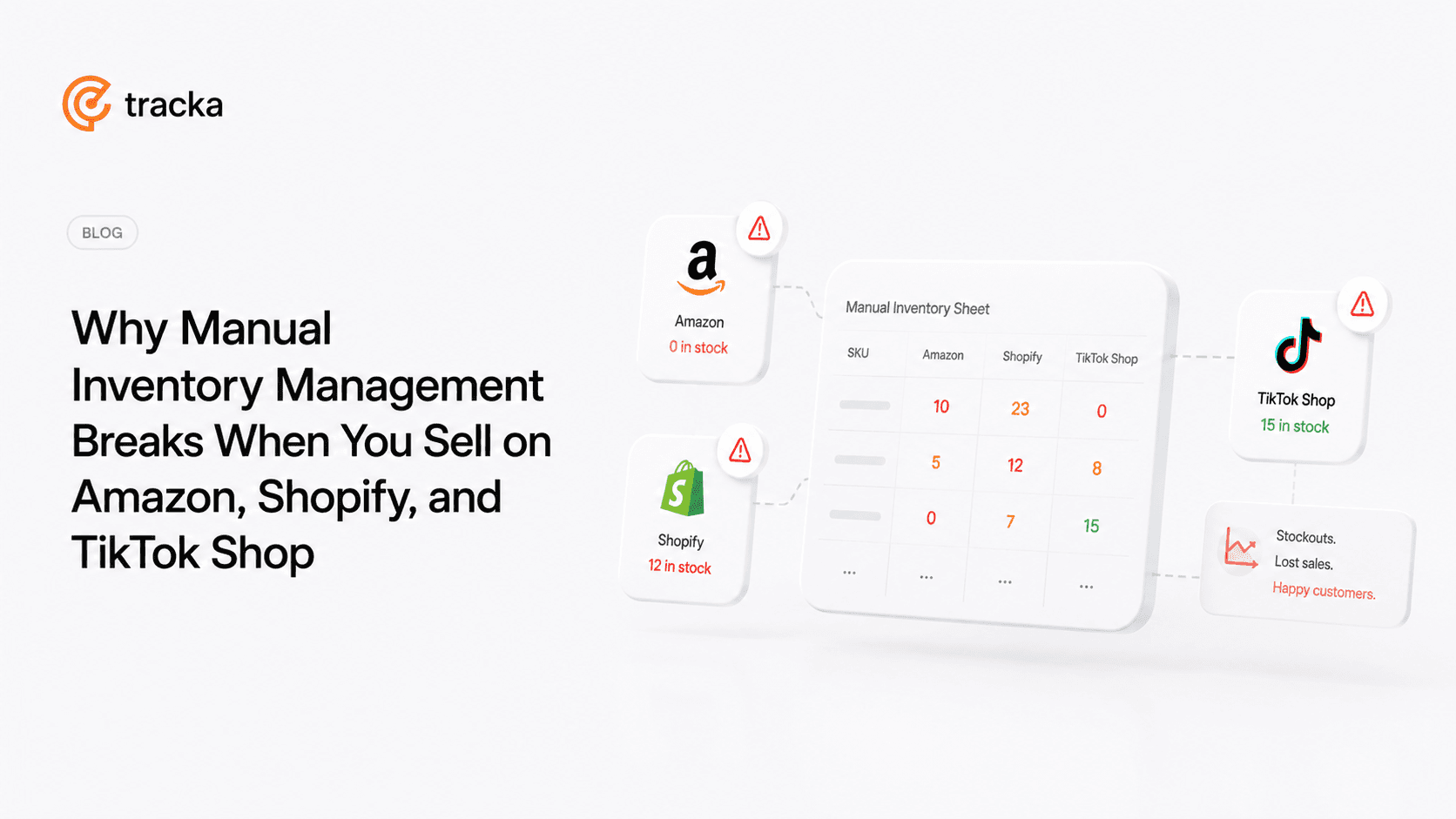
Amazon does not know what just sold on Shopify.
Shopify does not know what just sold on TikTok Shop.
TikTok Shop does not know what just sold on Amazon.
Now you are splitting one pool of stock across multiple systems that do not naturally share updates in real time.
That might be survivable when order volume is low. It completely fails during:
viral product moments
creator campaigns
paid traffic spikes
product launches
seasonal peaks
And those are exactly the moments growing ecommerce brands should be trying to create, not fear.
Research across recent ecommerce operations coverage points to near real-time inventory updates as the safer standard once brands are selling across multiple channels. Once sync delays stretch beyond a few minutes, the risk of overselling during high-volume periods rises fast.
Spreadsheets vs real-time inventory sync software
Manual spreadsheets | Real-time inventory sync software |
|---|---|
Inventory updated after the sale | Inventory updated across channels as the sale happens |
One person has to remember every change | System applies updates automatically |
Easy to oversell during spikes | Much lower oversell risk during spikes |
Hard to trust reorder timing | Low-stock alerts and reorder visibility |
Stock counts vary by platform | One source of truth across channels |
Reactive and stressful | Predictable and scalable |
That difference is bigger than convenience.
It changes whether you can scale safely or not.
Why each platform creates a different inventory problem
Amazon punishes mistakes the fastest
Amazon is usually the harshest place to get inventory wrong.
If you are running FBA, FBM, Shopify, TikTok Shop, Etsy, or Walmart together, the complexity stacks fast. Every canceled order hits harder because Amazon does not care why it happened. It only sees that the customer placed an order and you did not fulfill it.
So if a product goes viral on another channel and your stock updates late, Amazon is often where the damage shows up first.
That means you can end up paying for traffic, winning clicks, and still losing money because the unit was already sold somewhere else.
Shopify creates the illusion that inventory is under control
Shopify looks cleaner because it is your home base, but that can be misleading.
Shopify tracks inventory by location, status, and fulfillment source, which is helpful. But once you are also selling through marketplaces and 3PLs, you still need one central source of truth. Otherwise your Shopify number might say one thing while Amazon, a warehouse app, or another sales channel says something else.
That is how operators end up with 100 units on hand but far fewer actually available to sell.
TikTok Shop has a hidden reservation problem
This is one of the biggest inventory traps we have seen, and almost nobody explains it clearly.
During live selling and high-intent shopping moments, some inventory can get tied up in reserved or pending states before checkout is fully completed. In plain English, someone adds your product to cart, starts checkout, and that stock can sit in limbo for a while instead of becoming immediately sellable again.
So you might think you have 50 units available.
In reality, only 30 are truly sellable.
That gets dangerous fast when TikTok traffic is hitting at the same time as Shopify and Amazon. Now your visible inventory is no longer your real inventory, and manual math becomes useless.
This is why TikTok Shop can feel unpredictable to operators. Demand spikes faster, creator traffic is less linear, and reserved inventory can distort what looks available in the moment.
What we learned the hard way
The lesson for us was simple:
If you sell on multiple channels, you cannot manage inventory as a side task.
You need:
one real stock number
near real-time sync across channels
low-stock alerts before you hit danger zones
reorder visibility tied to sales velocity
a system that keeps working when traffic spikes
We built Tracka because we needed that ourselves.
If you are still updating stock manually across Amazon, Shopify, and TikTok Shop, you do not have an inventory process. You have a timing problem that just has not blown up yet.
And when it does, it usually happens on the day demand finally shows up.
If you want to stop overselling, protect your marketplace health, and actually trust your stock numbers, take a look at Tracka. It is the system we wish we had before the day we went viral.